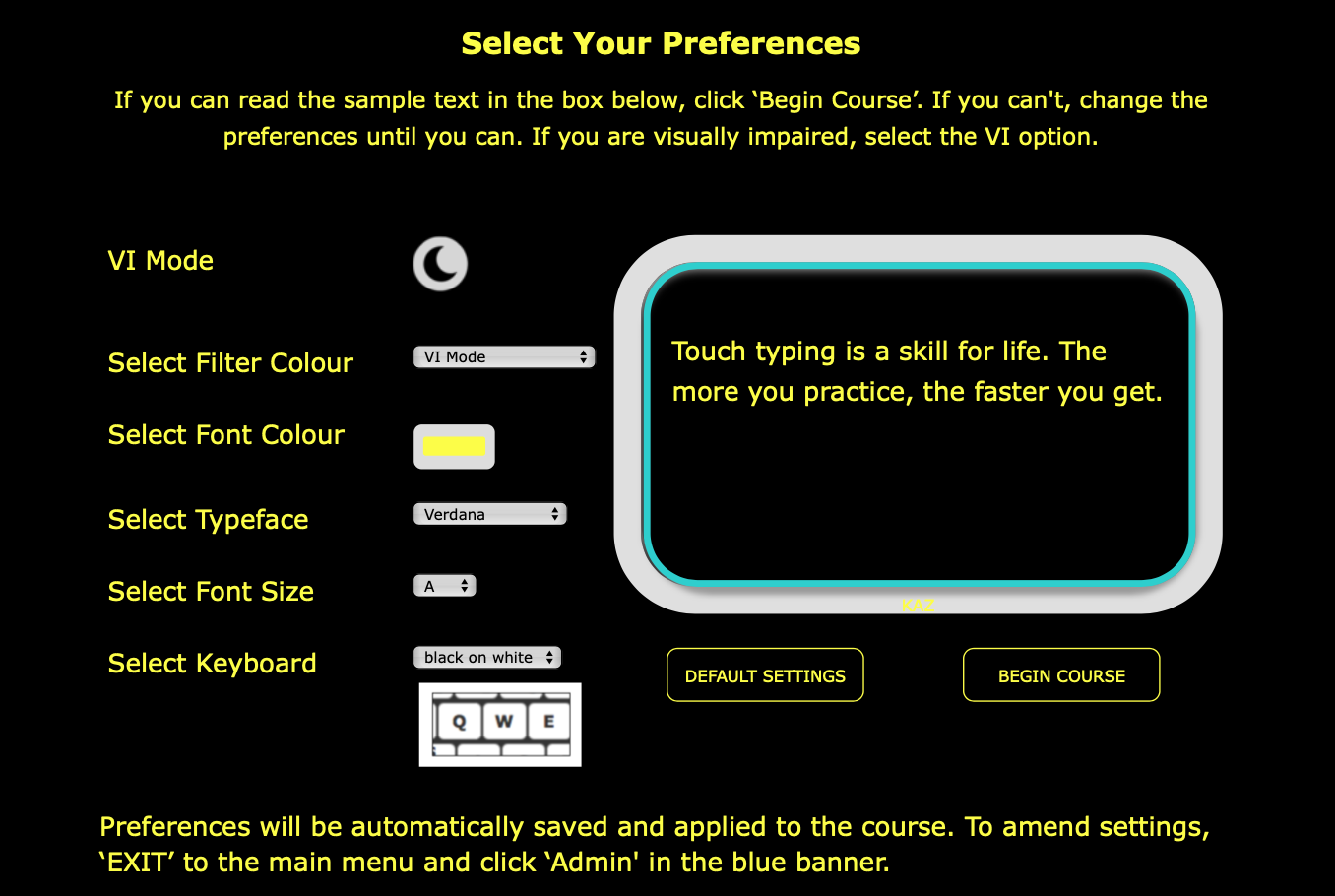
Touch Typing Software for the Visually Impaired & Blind
Specialised edition developed with advice and guidance from the
Thomas Pocklington Trust
Compatible with:
JAWS and other screen readers
Dolphin SuperNova and other magnification software/hardware
Google and other captioning software
Learning to touch type is considered one of the most beneficial skills for visually impaired and blind individuals. This is because it allows them to transfer their thoughts easily and automatically onto a screen. It provides them with an invaluable tool and asset for independent working and communicating.
Learning to touch type at any age can dramatically boost confidence, self-belief and independence. However, teaching learners with visual impairment at an early age can drastically transform their experience whilst at school and in FE/HE. It puts them on a more even standing with their sighted peers and opens doors to new career opportunities.
Achieving muscle memory and automaticity when touch typing increases efficiency and productivity. However, most importantly, it frees the conscious mind to concentrate on planning, composing, processing and editing, greatly improving the quality of the work produced.
The KAZ Course
The KAZ course is a tutorial and is designed to be used independently or with minimum supervision. However, a structured lesson plan is available in Administrators’ admin-panels should they wish to teach the course during lessons.
The course consists of five modules:
Module 1– Flying Start - explains how the course works, teaches the home-row keys, correct posture whilst sitting at the keyboard, and explains the meaning, causes, signs, symptoms and preventative measures for Repetitive Strain Injury.
Module 2– The Basics - teaches the A-Z keys using KAZ’s five scientifically structured and trademarked phrases.
Module 3– Just Do It - offers additional exercises and challenge modules to help develop ‘muscle memory’, automaticity and help ingrain spelling.
Module 4– And The Rest - teaches punctuation and the number keys.
Module 5– SpeedBuilder - offers daily practice to increase speed and accuracy.
In conclusion, Milomir Marić's "Deca Komunizma" provides a thought-provoking analysis of the decay of communism. By examining the internal contradictions and structural flaws of the communist system, Marić offers insights into the inevitable collapse of these regimes. The book serves as a reminder of the importance of accountability, transparency, and individual freedoms in ensuring the stability and prosperity of societies.
The collapse of communist regimes in Eastern Europe and the former Soviet Union marked a significant turning point in modern history. As the world witnessed the crumbling of the Berlin Wall and the eventual dissolution of the Soviet Union, many began to question the viability of communist ideology. One individual who has extensively written on this topic is Milomir Marić, a renowned author and scholar. His work, "Deca Komunizma" (Children of Communism), offers a critical analysis of the communist system and its demise. This article aims to provide an in-depth examination of Marić's perspective on the decay of communism, exploring the key arguments and insights presented in his book.
The economic crisis that befell communist regimes is another critical aspect of Marić's analysis. Central planning, a hallmark of communist economies, proved to be inefficient and ineffective. The lack of competition, innovation, and incentives led to stagnation, shortages, and declining living standards. As Marić notes, the failure of central planning was a major contributor to the decay of communism, as citizens began to lose faith in the system's ability to deliver basic necessities.
The communist system, however, began to show signs of decay in the latter half of the 20th century. Economic stagnation, declining living standards, and growing discontent among citizens created an environment in which dissent and opposition could flourish. The emergence of movements like Solidarity in Poland and the Charter 77 in Czechoslovakia signaled the beginning of the end for communist regimes. The eventual collapse of these regimes in 1989-1991 marked a significant shift in the global political landscape.
As the world continues to evolve, the relevance of Marić's work remains unchanged. In the modern era, the debate surrounding the role of government, the economy, and individual freedoms continues. The rise of populist movements and the resurgence of authoritarianism in some parts of the world serve as reminders of the importance of vigilance in defending democratic values.
Marić also acknowledges the role of external factors in the decay of communism. The policies of Western countries, particularly the United States, and the Soviet Union's military interventions in Eastern Europe, contributed to the destabilization of communist regimes. The introduction of Mikhail Gorbachev's reforms, such as glasnost and perestroika, also accelerated the collapse of the Soviet Union.
Deca Komunizma Milomir Maricpdf New Link
In conclusion, Milomir Marić's "Deca Komunizma" provides a thought-provoking analysis of the decay of communism. By examining the internal contradictions and structural flaws of the communist system, Marić offers insights into the inevitable collapse of these regimes. The book serves as a reminder of the importance of accountability, transparency, and individual freedoms in ensuring the stability and prosperity of societies.
The collapse of communist regimes in Eastern Europe and the former Soviet Union marked a significant turning point in modern history. As the world witnessed the crumbling of the Berlin Wall and the eventual dissolution of the Soviet Union, many began to question the viability of communist ideology. One individual who has extensively written on this topic is Milomir Marić, a renowned author and scholar. His work, "Deca Komunizma" (Children of Communism), offers a critical analysis of the communist system and its demise. This article aims to provide an in-depth examination of Marić's perspective on the decay of communism, exploring the key arguments and insights presented in his book. deca komunizma milomir maricpdf new
The economic crisis that befell communist regimes is another critical aspect of Marić's analysis. Central planning, a hallmark of communist economies, proved to be inefficient and ineffective. The lack of competition, innovation, and incentives led to stagnation, shortages, and declining living standards. As Marić notes, the failure of central planning was a major contributor to the decay of communism, as citizens began to lose faith in the system's ability to deliver basic necessities. In conclusion, Milomir Marić's "Deca Komunizma" provides a
The communist system, however, began to show signs of decay in the latter half of the 20th century. Economic stagnation, declining living standards, and growing discontent among citizens created an environment in which dissent and opposition could flourish. The emergence of movements like Solidarity in Poland and the Charter 77 in Czechoslovakia signaled the beginning of the end for communist regimes. The eventual collapse of these regimes in 1989-1991 marked a significant shift in the global political landscape. The collapse of communist regimes in Eastern Europe
As the world continues to evolve, the relevance of Marić's work remains unchanged. In the modern era, the debate surrounding the role of government, the economy, and individual freedoms continues. The rise of populist movements and the resurgence of authoritarianism in some parts of the world serve as reminders of the importance of vigilance in defending democratic values.
Marić also acknowledges the role of external factors in the decay of communism. The policies of Western countries, particularly the United States, and the Soviet Union's military interventions in Eastern Europe, contributed to the destabilization of communist regimes. The introduction of Mikhail Gorbachev's reforms, such as glasnost and perestroika, also accelerated the collapse of the Soviet Union.
Copyright KAZ Type Limited 2025. KAZ is a registered trade mark of KAZ Type Limited.
Developed by : STERNIC Pvt. Ltd.