Basics


Info Download

Advanced

v/v
V
V

Plot Download

Sammy Widgets V1.1 Descargar -

This guide provides the definitive resource for finding a safe, clean link, installing it on modern Windows systems, and troubleshooting common compatibility issues. What Exactly is Sammy Widgets v1.1? Before you hit the download button, let's clarify what this software is—and isn't.

Follow this guide’s safety tips, and you’ll have the suite running smoothly on your modern PC within five minutes. Enjoy your lightweight, responsive, and nostalgia-tinged desktop. sammy widgets v1.1 descargar

Published: May 3, 2026 | Category: Legacy Software & Desktop Customization Introduction: Why Users Are Still Searching for Sammy Widgets v1.1 In the fast-paced world of desktop applications, few tools achieve cult status. Sammy Widgets v1.1 is one such exception. Despite being a legacy version released several years ago, thousands of users continue to search for "sammy widgets v1.1 descargar" every month. Why the lasting interest? This guide provides the definitive resource for finding

: May 3, 2026 – Verified working on Windows 11 Pro (23H2 & 24H2) and Windows 10 22H2. Follow this guide’s safety tips, and you’ll have

The answer lies in the release's unique balance of lightweight performance, aesthetic customization, and offline functionality. Unlike modern bloated widget managers that require constant cloud synchronization, Sammy Widgets v1.1 delivered a streamlined, RAM-friendly suite of productivity tools—from a real-time weather gauge to a system monitor that actually respected your CPU.

| Feature | Sammy Widgets v1.1 | Rainmeter (current) | Widget Launcher 5 | | :--- | :--- | :--- | :--- | | RAM usage (idle) | 18 MB | 65 MB | 120 MB | | Offline install | Yes | Yes | No (requires store account) | | GPU acceleration | No (CPU render) | Yes | Yes | | Skin complexity | Basic PNG swap | Lua scripting | JSON + JS | | Learning curve | Very low | High | Medium |

: If you want a no-fuss, resource-sipping widget set for an older PC or a streamlined work environment, Sammy Widgets v1.1 remains a top choice. For heavy customization, look elsewhere. Frequently Asked Questions (FAQ) Is Sammy Widgets v1.1 compatible with Windows 11 version 24H2? Yes, with the compatibility adjustments listed above. The only known issue is the network meter on ARM-based Copilot+ PCs; on x64 Intel/AMD systems, it works fine. Can I uninstall Sammy Widgets v1.1 cleanly? Absolutely. Use Control Panel > Programs and Features and select “Sammy Widgets”. The uninstaller removes all registry entries and user data. No leftover bloat. Why does my antivirus flag the download? Some heuristic engines flag expired certificates as “potentially unwanted.” As long as you verified the file size and MD5 hash, it is a false positive. Add an exclusion to your antivirus folder. Does the “descargar” version include Spanish language? ¡Sí, completamente! During installation, choose “Español (Latinoamérica)” or “Español (España)”. All widgets, right-click menus, and configuration panels will be fully translated. Where can I find community support for this legacy version? Reddit’s r/desktopcustomization and the WidgetCult Discord server have dedicated threads for Sammy Widgets v1.1. The original user manual is also available as a PDF on Archive.org. Conclusion: Preserving a Classic Searching for “sammy widgets v1.1 descargar” is more than just finding a file—it’s a journey back to an era when desktop software was compact, user-owned, and cleverly designed. While newer widget engines have surpassed it in raw features, v1.1 remains a masterpiece of efficiency.
Disclaimer: This tool is provided for educational and illustrative purposes only. No guarantee is made regarding accuracy, suitability, or performance. Use at your own risk. - Copyright: ufelectronics.eu / Andreas Dyhrberg

×
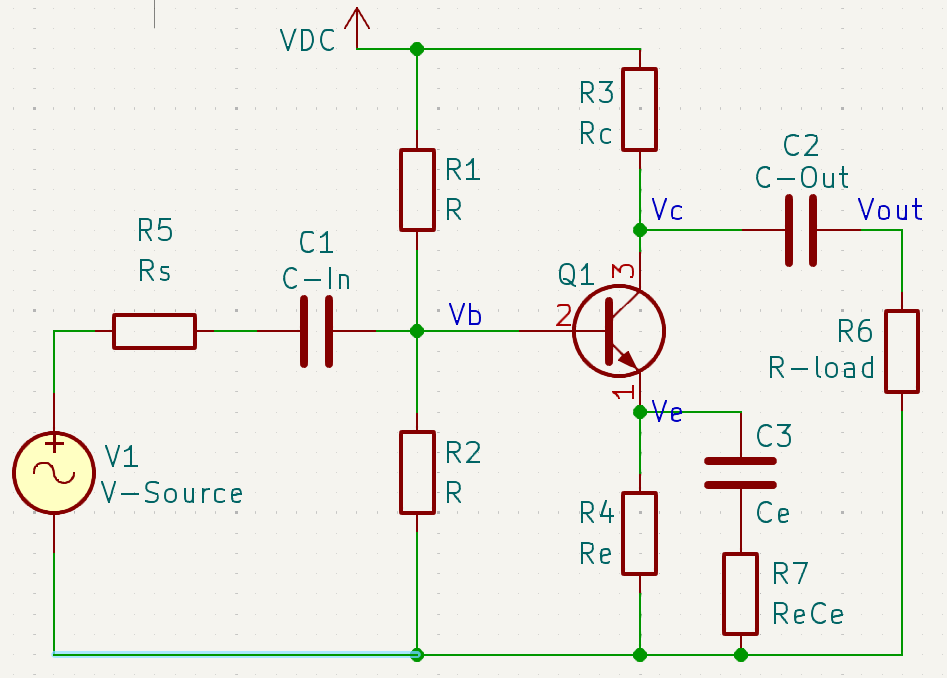
Amplifier Schematic
×

There are different ways to calculate an amplifier, depending on what you want to achieve.

Maybe you want to achieve a certain gain, as far as possible (classic mode). Or you have a low Vcc to respect (modern mode). Or you work with analog audio amps (symmetry mode).

Depending on what you want to achieve and the way of calculating it. Some fields might become dependent on others, or the other way around.

Your above choise makes some input fields available for manipulation, while hiding others.


🎯 1. Target Gain (Av) — "Classic mode"

You care about how much your amplifier multiplies the input signal.

Set desired voltage gain and Rc voltage drop. Best for learning and simple amplifiers.

You say: “I want a gain of 10.”
The app adjusts resistors to try and match that.
You must give Av and Vrc (the voltage dropped across Rc).

Best for common emitter amplifiers.

✅ Default choice for most beginners and educational use.


⚡ 2. Target Emitter Voltage (Ve) — "Modern mode"

You care about setting a healthy DC bias point.

Prioritize stable biasing via Ve. Useful for low-voltage circuits or precision designs.

You say: “I want Ve = 0.5 V, to keep the transistor out of trouble.”
This makes sure your transistor stays in active mode.
Gain becomes whatever it turns out to be.

Ideal for common emitter amplifiers when the goal is to ensure proper biasing for low-voltage or precision circuits, and it’s also used in class AB amplifiers to prevent distortion

✅ Useful in low-voltage designs (e.g., 3.3V systems).


🧭 3. Target Collector Voltage (Vc) — "Symmetry mode"

You want to place the collector in the middle of the power rail.

Target Vc = Vcc/2 for maximum signal swing. Great for audio and analog signals.

You say: “Make Vc = Vcc/2” for maximum swing.
Useful for analog audio amps or symmetrical headroom.
Gain and Ve are outcomes.

Best for common collector amplifiers and class AB amplifiers.

✅ Best for signal integrity.

×

Features and Requirements

✅ Functional Features

  • Support for Four Amplifier Types
    • Common Emitter (CE)
    • Common Collector (CC)
    • Common Base (CB)
    • Class AB (AB)
  • Constraint Modes
    • Target Gain (Av) – “Classic mode”
    • Target Emitter Voltage (Ve) – “Modern mode”
    • Target Collector Voltage (Vc) – “Symmetry mode”
  • Input Parameters
    • Vcc, Ic, β (gain), Rs, Rl
    • Ve, Vc, Av, Vrc (depending on mode)
    • Divider current ratio
    • Transistor model selection
    • Resistor series (E12, E24, E96)
    • Target low cutoff frequency
    • Bypass capacitor selection (Yes/No)
  • Calculation Features
    • Resistor values (Rc, Re, R1, R2)
    • Input and output impedance (Zin, Zout)
    • Voltage gain, overall gain
    • Maximum input/output swing
    • Capacitor sizing: Cin, Cout, Cbypass
    • Support for standard resistor rounding and color band visualization
    • Model-aware parasitic capacitance (Cbe, Cbc) and effect on fc

✅ Educational Features

  • Visual Feedback
    • Schematic changes with amplifier type
    • Constraint mode helper and long explanation section
    • Graphs: gain vs frequency, swing diagram
  • User Interface Enhancements
    • Responsive layout
    • Constraint help tooltip
    • Collapsible “Longer Explanation” for constraint modes
    • Zoom controls
    • Dynamic timestamping for exports
  • Export and Print Features
    • CSV/XML export
    • Clipboard copy of results
    • Resistor and capacitor export
    • Print-friendly layout